
De-ToxerMax
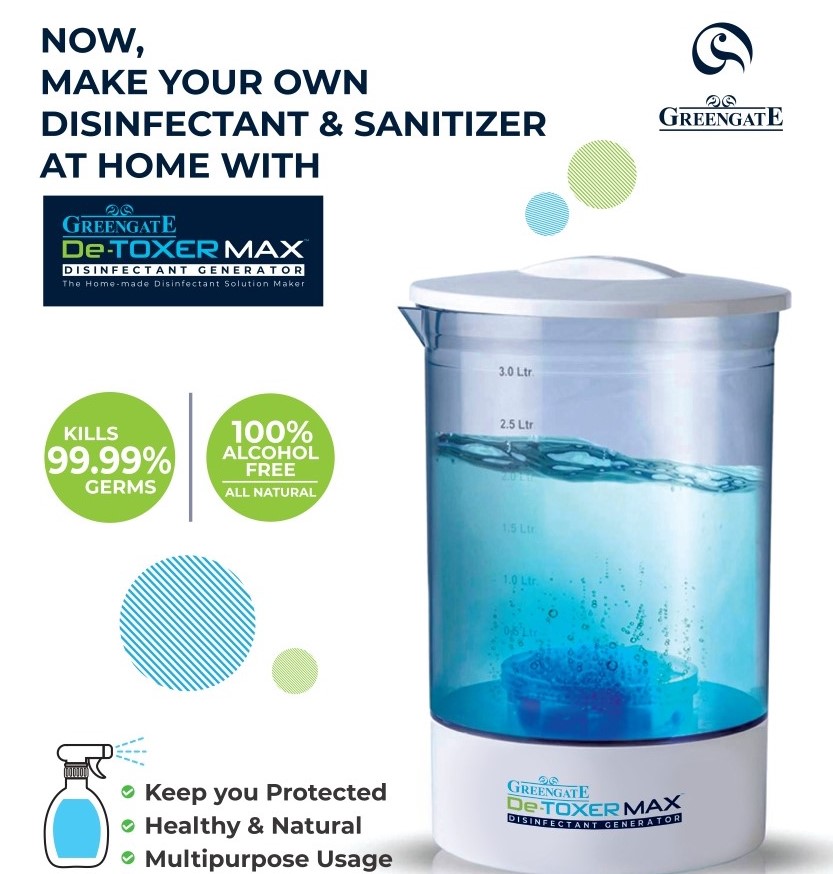
De-ToxerMax generates 3 litres of Hypochlorous Acid (HOCl) disinfectant in 3 minutes using salt, water, vinegar and electricity. As a disinfectant, it is a powerful oxidant that is 100 times more powerful than chlorine bleach. It uses water and table salt to generate disinfectant at home.

WhyDe-ToxerMax
Hypochlorous acid (HOCl) also called electrolyzed water is an all-natural, non-toxic, and non-hazardous solution that can be used for disinfecting or degreasing. As a cleaner and degreaser, it is a powerful reducing agent of potassium hydroxide (KOH) that can effectively dissolve water-insoluble substances. With the Hypoclean™ jug, you can generate both! Using table salt you can generate the hypochlorous acid disinfectant. Using postassium carbonate you can generate the cleaner and degreaser.
PRODUCT DESCRIPTION
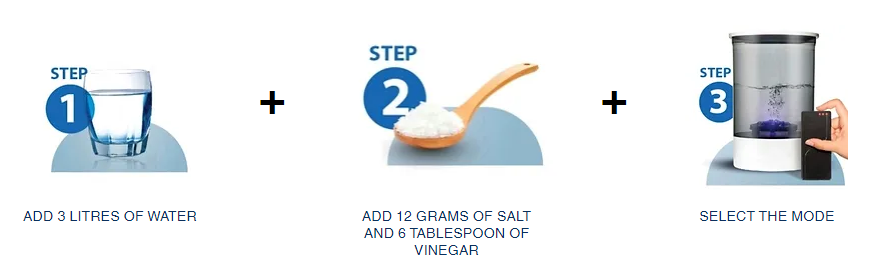
- Fill the jug with water.
- Add salt, vinegar and connect to the power source.
- Within 3 minutes, the disinfectant is ready.
By substituting table salt for food-grade potassium carbonate, floor tiles and toilet cleaner can be generated.
PERFORMANCE
Setting 1: 3 litre at 30 to 40 ppm in 3 minute
Setting 2: 3 litre at 50 to 60 ppm in 5 minutes
Setting 3: 3 litre at 80 to 100 ppm in 7 minutes
If more than 100ppm is required, run the 3rd setting again.
HOW TO USE
De-ToxerMax is simple. Just add water+salt+vinegar (no need to add anything else) Plugin the adapter and select from the 3 modes to make mild, moderate, or a strong disinfectant. Sit and relax for few minutes until the electrolysis process is finished.
What is HOCl?
- HOCl is the scientific formula for hypochlorous acid, a weak acid similar to that of a mild citrus juice.
- HOCl is made naturally by white blood cells in all mammals for healing and protection.
- HOCl is a powerful oxidant that is effective against invading bacteria, fungi, and viruses.
- Generating HOCl by running electricity through a solution of saltwater was discovered in 1970s.
- HOCl is now used in healthcare, food safety, water treatment, and general sanitation.
Why is HOCl more efficient at killing pathogens?
Hypochlorous Acid (HOCl) vs. Sodium Hypochlorite (Chlorine Bleach)
Hypochlorite ion carries a negative electrical charge, while hypochlorous acid carries no electrical charge. The hypochlorous acid moves quickly, able to oxidize the bacteria in a matter of seconds, while the hypochlorite ion might take up to a half hour to do the same. Germ surfaces carry a negative electrical charge which results in a repulsion of the negatively charged hypochlorite ion to the area of the germ surfaces, making hypochlorite ion less effective at killing germs. The ratio of the two compounds is determined by the relative acidity (pH) of the water. Water treatment specialists can adjust the pH level to make hypochlorous acid more dominate, as it is more efficient at killing bacteria. The hypochlorous acid’s lack of electrical charge allows it to more efficiently penetrate the protective barriers surrounding germs.
How does HOCl kill microbial pathogens?
The molecule of hypochlorous acid is HOCl. This molecule is unique in that it is neutrally charged unlike hypochlorite (OCl-) which is negatively charged. So why is this important?
Disinfectants and microbial pathogens interact with each other similar to magnets. If you bring together two negatively charged magnets, they will repel each other. Bacteria and hypochlorite (OCl- aka. bleach) are both negatively charged and behave like two negatively charged magnets repelling each other. Hypochlorous acid (HOCl) is neutrally charged and is not repelled by bacteria. HOCl easily penetrates the walls of the bacteria and destroys them with its strong oxidation potential.
Why is pH important?
A free available chlorine (FAC) molecule is one that is not attached. There are three forms of free available chlorine: chlorine gas, hypochlorous acid and hypochlorite. Assuming a constant temperature of 25 degrees Celsius, when the pH is below 3, free chlorine will leave solution as chlorine gas. When the pH is above 7.5, over 50% will be hypochorite (OCl-) and will increase in hypochlorite as it rises toward pH 14. Between pH 3 and pH 7.5 the free chlorine solution will be dominated by hypochlorous acid (HOCl).